The Psychology of Tarot
- Amber

- Jun 22
- 9 min read
Updated: Jul 9
Carl Jung, the founder of analytical Psychology, taught that there are universal roles and events encountered in life which influence the psyche, whether we are aware of it or not. He called these aspects Archetypes.
The Tarot also contains Archetypes, called the Major Arcana. Each of these cards represents an aspect of life. From each, we can either learn a Universal Truth, or misinterpret the lesson.
According to Jung, Archetypes belong to world hidden within a layer of the psyche, that is shared by all human beings. It is called the Unconscious. Through direct experience with these different aspects we learn more about our true nature. On an individual level, we have our own Conscious mind, into which we draw the information we have gained from the Unconscious.
When we have garnered enough universally true knowledge, we gain access to the Super Consciousness, a state of peace, understanding, and appreciation. At this this level, we have achieved the truest expression of ourselves and are able to inspire and uplift others.
Jung called the process of becoming one's authentic self "Individuation" and he believed it was our life's purpose. He also believed it was realistically attainable.
In the Tarot, these learning points begin with The Fool card, a naïve character set off on a journey. It is the number zero, a blank slate. He has not yet made any impressions of this world. This card symbolizes our arrival into the physical world.
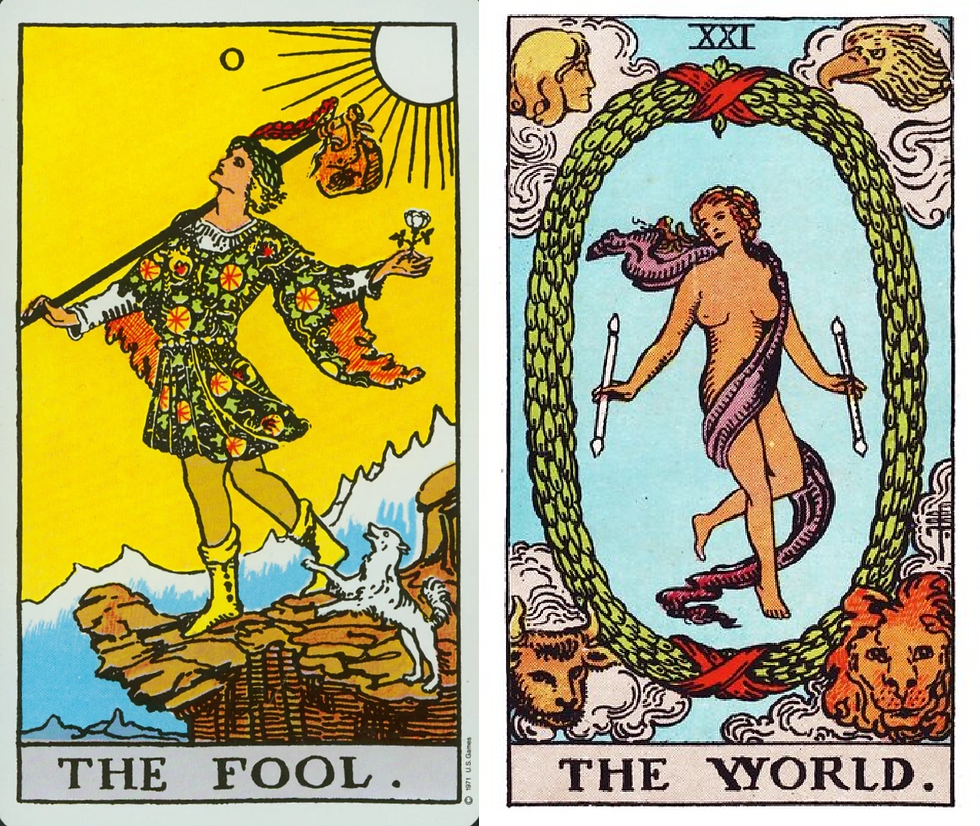
The last of the Archetypes is The World card, symbolizing a state of enlightenment that can only be reached by the direct experience of the many life lessons that fall in between.
One measure of how easily we will handle these life lessons concerns which type of persona we have. As children, we are dependent on our caregivers. Because of this, we try hard to make them happy. Whichever behaviors solicited the most approval from our parents then become our strongest traits, which may not be behaviors that are helpful as an adult. We also learned certain behaviors did not get the favorable attention we wanted, so we internalized that they were bad, regardless if it was true or not.
Knowing your personality type can be beneficial because it helps to learn your weak points and your strengths. Psychology and the Tarot both contain a list of the predominant personalities manifest in people. Remarkably, both have classifications for exactly 16 personalities.
The Myers-Briggs MBTI classifies 16 distinct personality types by four traits: extroversion/introversion, sensing/intuition, thinking/feeling, and judging/perceiving.
The 16 court cards of the Tarot (the King, Queen, Knight, and Page in the four different suits) each represent a unique persona.

Carl Jung explained that in order to integrate the Unconscious lessons effectively, we must undergo a process called Shadow Work. This is done by recognizing the parts of ourselves that have been falsely conditioned due to expectations of our family and society, or due to unhealed trauma. These shadow aspects of ourselves come to us in dreams; they're the different voices we hear in our heads.
The idea of Shadow Work also precedes Psychology. Shamans in tribal areas of Asia and Russia would conduct ceremonies using a drumming technique to reach a theta-state of meditation. They would then travel into the spirit world to search for the lost genuine parts of the traumatized person and convince the parts to return. It was known as Soul Retrieval.
Toxic Shame is a term coined by Dr. John Bradshaw in his book, "Healing the Shame that Binds You" (1988). This is where the term "being toxic" originated. He defines it as having parts of yourself that you are ashamed of, due to conditioning by your family and society, which limit your capacity for growth. With this book, he did a brilliant job of de-mystifying the signs of having deviations in the psyche. He clearly defines the hiding places of shame by listing the different human behaviors that give it away.

This makes it easy to discover the parts of us that we are overly-identifying with and the parts that we have disowned due to shame. In un-burdening ourselves from the shame, we begin to allow our true selves to shine through.
Note that in The World Tarot card, the figure is nude. Shame is a fear of exposure. The card symbolizes the overcoming of shame.
When we undo our conditioning, we become our true, unique selves. We begin to see each problem in life as a challenge to rise above. We start to enjoy life, our energy returns, and we become playful and creative. Moreover, we become resilient.
The traditional Tarot images we mostly see today are from the deck of Arthur Waite. Arthur Waite belonged to a secret mystical order called The Hermetic Order of The Golden Dawn, along with the infamous Magician Aleister Crowley. Crowley also created a Tarot deck, the Thoth Tarot, which has some very fascinating imagery.

Both adepts stated that these decks were created from a master deck that is privately owned by their Order. Initiation into this mystical order involves a process of mastering the four elements.
In the Tarot, there is a system of elements: the Wands represent Fire, Cups represent Water, Swords are Air, and Pentacles stand for Earth.
Initiates learn that that they must master the following: Fire (Will), Water (Feelings), and Air (Thinking). They do this in order to have access to higher worlds. Once this is achieved, they take an oath to help their fellow human being. This oath is the symbology of Earth.
It is emphasized that their growth could not have been facilitated without their experience on Earth, and had they not received the help of others along the way. Therefore, it would not be righteous to leave them behind.
Crowley and Waite created their Tarot decks in order to help others along the path. Waite said himself that the Tarot is a learning tool and that it wasn't intended for reading the future. He was disappointed when the cards became popularly used in fortune telling. The Hermetic way is not to anxiously worry about the future. It is to be fully present. It is a process of transforming yourself from the inside out to create a better future, or at least trust that you can take on whatever the future brings.
Waite did include a book of card meanings with the deck, along with a diagram of how to do readings, which included a space for possible futures and possible outcomes. This could have easily been misinterpreted. To clarify, these spaces are meant to show us what a likely probable outcome will be, if we continue to handle things in the same present manner. It is meant to call us on us to enact positive change. Once we see our blocks and blind spots, we are supposed to be inspired to alter our course to create a better outcome. We have free will.
The Tarot was intended to be used to read the energy of the present moment. By shuffling the cards, we create a random generator in a sense, allowing synchronicity to take place. The cards that come out then have a significant meaning to the subject in the current moment in time.

The origins of Tarot's teachings came from an Egyptian figure named Hermes Trismegistus (meaning Hermes the Thrice-Great). He was also called Thoth. He is credited with the creation of many branches of knowledge; including law, magic, philosophy, religion, science, and writing. He taught that the highest consciousness within humanity is divine awareness, stating that there is no difference between a person's innermost being and God.
The Tarot contains many Egyptian symbols. For instance, the Sphinxes on the Chariot card and Wheel of Fortune card. When Egypt fell at the rise of the Roman Empire, all of the knowledge was destroyed. The Library of Alexandria was burned to the ground. Hence the reason Hermetic teachings have long been carried on in secret. Anyone caught spreading this knowledge would have been tortured and killed.

Another reason this knowledge remained underground for so long was the Inquisition, a persecution of tribal and indigenous beliefs led by the Roman Catholic Church. This was a global threat that lasted from 1184 to 1821. Millions of people were tortured and killed, unless they adapted to the teachings of the Church.
Perhaps this is why the Church denounces Tarot. It could be that they did not want people having something else to believe in, so that they would rely on the Church. At this time, it was taught that the only person that could communicate with God was the Pope.
It's easy to see why the rumor of Tarot being evil was perpetuated by the common folk. They didn't want to see any more people getting killed.
These were the Dark Ages, a time when this Golden Knowledge was lost. We all know how horrible life was at that time.
Oddly enough, the Tarot is also full of pictures of Angels, Hebrew letters, and the Tetragrammaton (God's true unpronounceable name).

In ancient Egypt, doctors would first consider ailments of the soul as a potential cause when treating physical symptoms. Our current medical system separates the mind from the body and treats symptoms separately. However, we are beginning to realize that they are one in the same. Pain and sickness happen in the body when we have a fragmented part of ourselves that has been disowned for too long. That aspect of ourselves creates the physical symptoms in our body as a last ditch effort to call out for change.
Many psychiatric maladies derive from being out of touch with our feelings due to early conditioning or trauma. Murderers and sexual deviants are are the extreme example of what can happen when we are cut off from the sensory input of feelings.
However, when we overly identify with the feeling aspect of ourselves, the thinking mind goes haywire and wreaks havoc on our will.
We want what we want, when we want it.
OR
In Alcoholics Anonymous, this is known as "the self-will run riot". This imbalance leads to anxiety, fear, hyper-fixation, co-dependency, addictions, an obsession with control or power, compulsive disorders, etc. All of which affect us physically via the nervous system.
Addiction is the great unifying human experience. Dr. Bradshaw posits that all maladaptive behaviors are actually addictions because we can't stop doing them, and we do them to mood-alter. This is how people get stuck in destructive patterns, repeating the same situation over and over again.
We mood-alter in order numb the pain of not feeling whole. The loneliness felt by never getting to fully express our true selves is a pain felt around the clock.
Even socializing doesn't help. When we're amongst others, it becomes even more necessary to hold back the metaphorical barking dogs in our psyche. For this reason, people that have been greatly repressed may quickly become exhausted when socializing.
And presenting a false self means you never really get to connect with anyone. It can make even your intimate relationships feel lonely. Since we can't get happiness from interaction, the way we should be able to, we constantly seek out other outlets to fill that need.
The word Addiction is derived from the Latin word Addictus; meaning to sell out, betray, or abandon. Addictions distract us from doing the inner work, meaning we are betraying and abandoning ourselves--our lost selves.
The more addictions a person has, the more repression and trauma they have suffered. Addicts shouldn't be punished or shamed. It only adds insult to injury.
Psychology is still relatively new. It was established in 1879. The first edition of the Diagnostic and Statistical Manual of Mental Disorders (DSM-I) wasn't published until 1952.
There is a predominant notion that some mental health conditions are genetic and can only be treated with medication. I am not advising anyone to stop taking their medication, I am simply opening up a dialogue.
People are identifying with their illness. Once they are diagnosed, it becomes a self-fulfilling prophecy--for life. Fairly recently, in 2014, Dr. Bessel Van Der Kolk debunked the fact that mental health issues are purely biological and hereditary in his book, "The Body Keeps the Score".

His studies prove that while genetic pre-dispositions exist, it is always trauma that activates those defenses. He presents how the effects of trauma can be dismantled with many different healing modalities. He explains further that medication should be a last resort due to severe side effects such as apathy and suicidal thoughts.
Prescription drugs now kill more people in America every year than car crashes or guns. They might even be the cause of some car accidents or murders. The most disparaging sign of our times is that even children are being medicated, sometimes even at the toddler stage. There has to be a different way.
The teachings of the Tarot could be a great adjunct to therapy/psychiatric treatment. Tarot is quite possibly the precursor to Psychology as we know it today.
All signs point to the cards being a tool to enhance our consciousness. Although in some ways, things seem to be getting worse in the world, we are lucky to live in a time with open access to many forms of knowledge which we had previously been completely cut off from.
Modern advances are valuable, but so is the knowledge of our ancestors. At closer examination, it can be understood why this knowledge struggled to persevere against horrible odds, and I honor those that fought to conserve and spread this information. I've seen firsthand how it can lift you up from the lowest depths, but that's a story for another time.
Comments